
Verified appointment
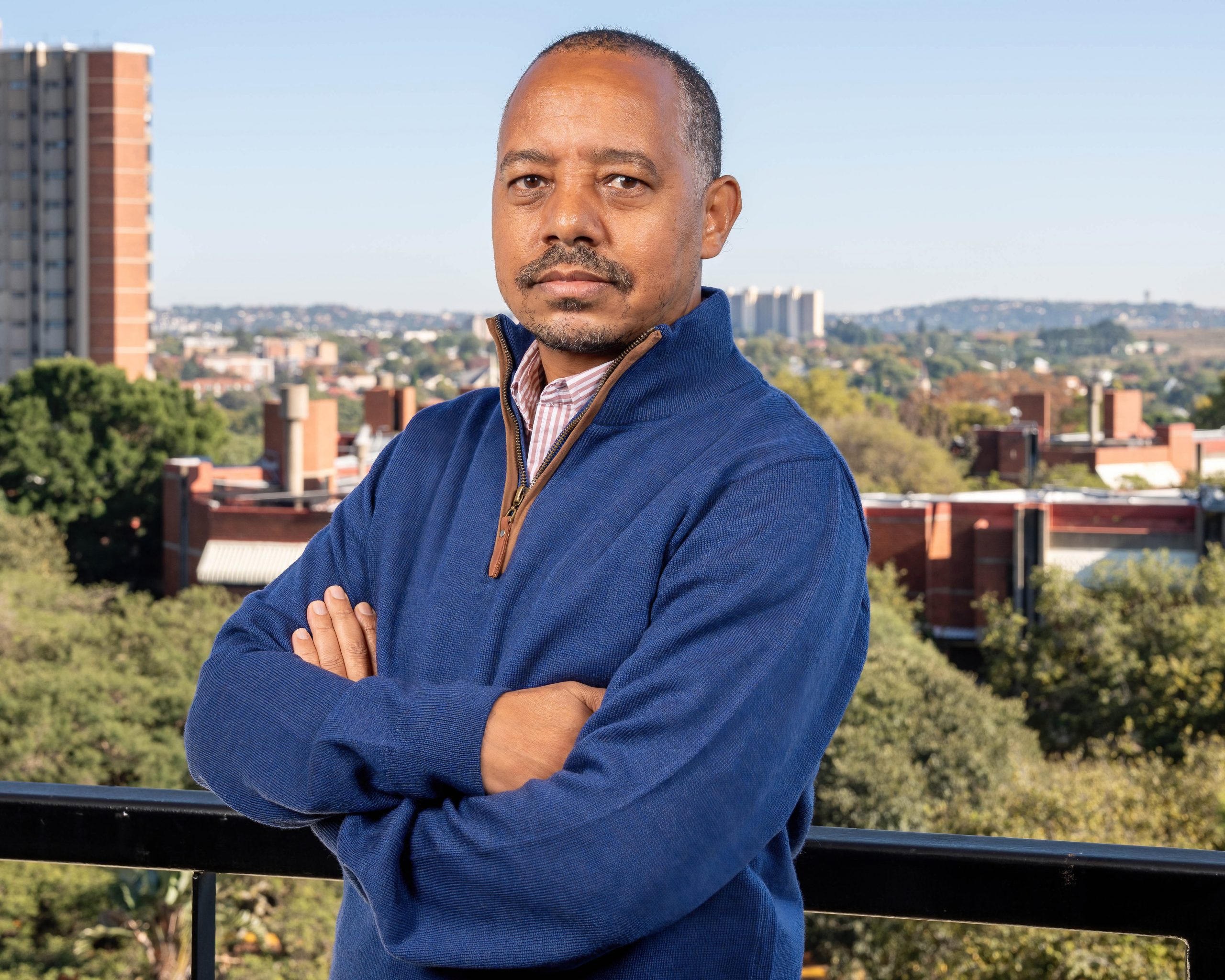
Prof Solomon Tesfamichael
Associate Professor
Prof Solomon G. Tesfamichael’s research revolves around the applications of Geographic Information System (GIS) and remote sensing to environmental and geographical resource assessment. He has expertise in the three main
Last reviewed: 2026/07/15
Suggest a correctionOverview
Prof Solomon G. Tesfamichael’s research revolves around the applications of Geographic Information System (GIS) and remote sensing to environmental and geographical resource assessment. He has expertise in the three main pillars of remote sensing, namely, optical/spectral, Light Detection and Ranging (LiDAR) and Radio Detection and Ranging (RADAR) remote sensing. Over the years, he has used these technologies to characterize and model natural, environmental and social processes at different spatial scales ranging from local to regional levels. Some of his research focusses that utilize the above remote sensing technologies and climatic data include spectral characterization of vegetation, water and soil; predicting vegetation characteristics and productivity; modelling wildfire trajectory; three-dimensional modelling of vegetation structures; soil moisture quantification and forecasting; and relating human health with socio-environmental factors. He is also passionate about integrating the three remote sensing technologies to maximize information extraction and improve mapping/modelling accuracies. Recent Publications Makwinja, R., Curtis, S.G. and Tesfamichael, S.G . 2024. Vulnerability of Ecosystem Services and Functions of Elephant Marsh, Malawi, to Land Use and Land Cover Change. Wetlands . Accepted. Shinga, P.S., Tesfamichael, S.G. , Sibandze, P., Kalumba, A.M. and Afuye, G.A. 2024. Modelling spatiotemporal patterns of wildfire risk in the Garden Route District biodiversity hotspots using analytic hierarchy process in South Africa. Natural Hazards . https://doi.org/10.1007/s11069-024-06877-7 Hlatshwayo, S.N., Tesfamichael, S.G. and Kganyago, M. 2024. Predicting tropospheric nitrogen dioxide column density in South African municipalities using socio-environmental variables and Multiscale Geographically Weighted Regression. PLoS ONE . 19(8): e0308484. https://doi.org/10.1371/journal.pone.0308484 Rodgers Makwinja, Yoshihiko Inagaki, Solomon G. Tesfamichael , Christopher J. Curtis. 2024. Novel methods for monitoring low chlorophyll-a concentrations in the large, oligotrophic Lake Malawi/Nyasa/Niassa. Journal of Environmental Management . 364, 121462. https://doi.org/10.1016/j.jenvman.2024.121462 de Villiers, C., Munghemezulu, C., Tesfamichael, S.G. , Mashaba-Munghemezulu, Z. and Chirima, G.J. 2024. Mapping smallholder maize farm distribution using multi-temporal Sentinel-1 data integrated with Sentinel-2, DEM and CHIRPS precipitation data in Google Earth Engine. South African Journal of Geomatics. 13(2), 321–351. https://dx.doi.org/10.4314/sajg.v13i2.7 de Villiers, C., Mashaba-Munghemezulu, Z., Munghemezulu, C., Chirima, G.J. and Tesfamichael, S.G. Assessing Maize Yield Spatiotemporal Variability Using Unmanned Aerial Vehicles and Machine Learning. Geomatics . 4, 213–236. https://doi.org/10.3390/geomatics4030012 Moeti, T, Mokhele, T, Tesfamichael, S . 2024. Associating socioeconomic factors with access to public healthcare facilities using Geographically Weighted Regression in the City of Tshwane, South Africa. Geospatial Health . Accepted. Solomon G. Tesfamichael , Yegnanew A. Shiferaw and Tsehaie Woldai. 2023. Forecasting monthly soil moisture at broad spatial scales in sub-Saharan Africa using three time-series models: evidence from four decades of remotely sensed data, European Journal of Remote Sensing . 56:1, 2246638, DOI: 10.1080/22797254.2023.2246638 Moeti, T, Mokhele, T, Weir-Smith, G, Dlamini, S, Tesfamichael, S . 2023. Factors affecting access to public healthcare facilities in the City of Tshwane, South Africa. J. Environ. Res. Public Health . 20, 3651. https://doi.org/10.3390/ijerph20043651 . Solomon G. Tesfamichael , Solomon W. Newete, Elhadi Adam and Marcus J. 2022. Discriminating pure Tamarix species and their putative hybrids using field spectrometer. GeocartoInternational . 37:25, 7733–7752. https://doi.org/10.1080/10106049.2021.1983033 . External Links Google Scholar ORCiD